
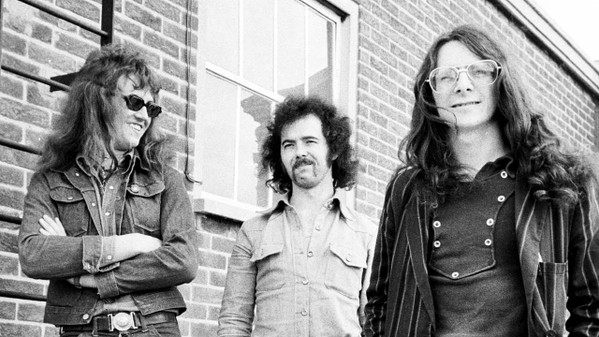
Budgie
Years Active: 1967 - 2010
Hometown: Cardiff
Genre: Heavy Rock
Lineup:
John Burke Shelley
Tony Bourge
Ray Phillips
Budgie are one of Wales’s great musical exports. Formed in Cardiff in 1967, they were pioneers of British heavy rock and are frequently cited as one of the earliest heavy metal bands. Their combination of thunderous guitar riffs, pounding rhythms, blues influences and the extraordinary high-pitched vocals of frontman John Burke Shelley helped lay foundations for the heavier music that followed. They were also responsible for some wonderfully eccentric song titles, proving that a band could be both seriously heavy and gloriously odd.
The original line-up featured John Burke Shelley (born 10 April 1947, bass and vocals), Tony Bourge (born 23 November 1948, guitar and vocals) and Ray Phillips (drums). Initially performing under names including Hills Contemporary Grass and Six Ton Budgie, they eventually settled on the rather more memorable Budgie. Their first gigs were around South Wales, and by 1968 they were developing the sound that would eventually take them onto the international stage.
Signed to MCA Records, Budgie released their debut single, Crash Course in Brain Surgery, in 1971, backed with Nude Disintegrating Parachutist Woman. Their self-titled debut album followed that year, produced by Rodger Bain, who had also worked with Black Sabbath. Recorded at Rockfield Studios in Monmouthshire, it established their distinctive sound: heavy, blues-based rock with a progressive edge and a willingness to stretch out into lengthy instrumental passages. Tracks such as Guts and Homicidal Suicidal gave an early indication of their musical imagination.
The follow-up, ‘Squawk’, arrived in 1972, but it was their third album, ‘Never Turn Your Back on a Friend’ (1973), that really cemented their reputation. Featuring the magnificent Breadfan, alongside Parents and In the Grip of a Tyrefitter’s Hand, it remains one of the defining albums of early British heavy rock. Breadfan would later become a favourite of Metallica, who recorded their own version, while they also covered Crash Course in Brain Surgery.
The fourth album, ‘In for the Kill!’ (1974), brought a change of personnel. Ray Phillips left in 1974 and was replaced by Pete Boot, who himself departed later that year. Steve Williams then took over on drums, beginning a long association with the band. The title track and Zoom Club demonstrated that Budgie were becoming increasingly adventurous, combining their trademark heaviness with intricate arrangements and extended instrumental sections.
The Shelley–Bourge–Williams line-up recorded ‘Bandolier’ (1975), another strong entry in an increasingly impressive catalogue. ‘If I Were Britannia I’d Waive the Rules’ followed in 1976, before the band returned with ‘Impeckable’ in 1978. By this point Budgie had developed a substantial following, particularly among hard rock audiences in Britain and Europe.
Tony Bourge left after ‘Impeckable’, bringing an end to the original songwriting partnership with Shelley that had driven the band for more than a decade. He went on to form Tredegar with former Budgie drummer Ray Phillips. Guitarist Rob Kendrick, formerly of Trapeze, briefly took Bourge’s place before John Thomas, previously of the George Hatcher Band, became the new permanent guitarist. Burke Shelley later told the rock fanzine On The Level that Kendrick had been a bit too flash for Budgie – a typically blunt assessment of the band’s approach to musical excess.
The new line-up relocated to the United States for a period, spending several years touring and developing a particularly strong following there. Budgie returned to Britain and signed to RCA Records, releasing ‘Power Supply’ in 1980, followed by ‘Nightflight’ (1981) and ‘Deliver Us from Evil’ (1982). The new material had a harder, more metallic edge, fitting neatly into the emerging New Wave of British Heavy Metal. The band toured extensively, including dates with Ozzy Osbourne, and headlined the Reading Festival in 1982. They also became one of the first Western heavy metal bands to perform in Poland during the Communist era.
Despite their influence and dedicated following, commercial success remained elusive. Budgie stopped regular touring in 1987, with their final original-era performances taking place around 1988. The members moved into other musical activities, although Shelley would not leave the Budgie name behind for long. He also formed a new trio, Superclarkes, during the period away from the band.
Budgie’s influence continued to grow during their absence. Metallica’s 1987 cover of Crash Course in Brain Surgery, followed by their version of Breadfan, introduced the band to a new generation of metal fans. Soundgarden also recorded Homicidal Suicidal, while other artists continued to acknowledge the importance of the Welsh trio’s pioneering heavy sound.
Burke Shelley revived Budgie in the mid-1990s for selected appearances, before a more substantial reformation in 1999 with John Thomas and Steve Williams. The band returned to the stage in 2001, but Thomas suffered a stroke and was forced to leave in 2002. Andy Hart took over on guitar, and the trio toured extensively in the UK and overseas. Their live album ‘Life in San Antonio’ documented the new line-up, with the recording released in January 2003.
Andy Hart’s time in the band was relatively brief. Simon Lees took over guitar duties later in 2003, and the new trio enjoyed a successful return to the UK touring circuit in 2005. The long-awaited new studio album, ‘You’re All Living in Cuckooland’, finally appeared in November 2006 – their first studio album in 24 years. The record included the characteristically Budgie-like I’m Compressing the Comb on a Cockerel’s Head, proving that the band’s taste for the unconventional remained intact.
Simon Lees later departed, with Andy James and, subsequently, Craig Goldy among the guitarists associated with the later line-up. Budgie continued performing until 2010, when Burke Shelley’s health problems forced the cancellation of further touring. He died in Cardiff on 10 January 2022, aged 74.
Budgie may never have enjoyed the commercial recognition of Black Sabbath, Led Zeppelin or Deep Purple, but their influence is undeniable. Metallica, Soundgarden and numerous other artists have covered or acknowledged their music. From the South Wales clubs of the late 1960s to the international heavy metal circuit, Burke Shelley, Tony Bourge and Ray Phillips helped create a sound that was years ahead of its time.
The Budgie musical story also continued into the next generation: Burke Shelley’s son Nathaniel became a member of the band Transposer. But it is the original Budgie catalogue, and that remarkable run of albums through the 1970s and early 1980s, that remains their lasting monument.
Further reading and listening
Discography
| Year | Album |
|---|---|
| 1971 | ‘Budgie’ |
| 1972 | ‘Squawk’ |
| 1973 | ‘Never Turn Your Back on a Friend’ |
| 1974 | ‘In for the Kill!’ |
| 1975 | ‘Bandolier’ |
| 1976 | ‘If I Were Britannia I’d Waive the Rules’ |
| 1978 | ‘Impeckable’ |
| 1980 | ‘Power Supply’ |
| 1981 | ‘Nightflight’ |
| 1982 | ‘Deliver Us from Evil’ |
| 2006 | ‘You’re All Living in Cuckooland’ |
Archive entry last updated: 27 November 2026